






6 Benefits of Training with Parallettes
Two small wooden bars that quietly unlock a whole tier of bodyweight training most people will never touch from the floor.

Parallettes are one of those rare tools that look almost too simple to matter. Two small bars, a few inches off the ground. But the second you start using them, you realize they change how every pushing movement feels and open the door to skills you can't even attempt without them. Here's what they actually do for your training.
01Neutral wrist position
This is the one most lifters feel first. Pushing off the floor forces your wrists into a fully extended position, which is fine for low volume but starts to ache the moment you ramp up your pushup work. Parallettes put your hands in a neutral grip with the wrist stacked over the forearm. The result is zero compression on the wrist joint, even at high volume.
If you've ever had to stop a pushup set because of wrist pain rather than chest fatigue, this is the fix. People with old wrist injuries, gymnasts, and lifters working through tendon issues all rely on parallettes for exactly this reason.
02Deeper range of motion on every pushing movement
Because your hands are elevated, your chest can drop below the level of your hands at the bottom of each rep. That extra inch or two of range puts the pec under a longer stretch and recruits more muscle fiber than a standard floor pushup ever could.
Long muscle lengths are where most hypertrophy actually happens. Adding parallettes to your pushup work is one of the simplest ways to get more growth out of the same number of reps.

03A real path to handstand pushups
Handstand pushups on the floor cap out at about head-to-floor depth, which is barely more than half range. Parallettes let your head drop below your hands, giving you the same deep stretched position that makes shoulder pressing actually grow muscle.
They also give you something to balance on that's more stable than splayed fingers. The neutral grip turns a fragile floor balance into a controlled press, which is why every serious handstand athlete trains on parallettes for at least part of their work.
04Forearm and wrist strength as a byproduct
A parallette has a much smaller footprint than your open palm on the floor. Every rep on the bars demands a level of stabilization from your forearms and the small muscles around the wrist that flat-handed pushing never asks for.
Over time this builds genuine wrist resilience. The same joints that hurt at the start of a parallette program tend to feel bulletproof a few months in, because the stabilizers have caught up to what you're asking them to do.
05Wood feels different than anything else
Most parallettes on the market are powder-coated steel or plastic. Both get cold, both get slippery the moment your hands start to sweat, and neither feels particularly good under load. Wood is the opposite. It absorbs sweat instead of pooling it, warms to the temperature of your hand, and has a natural texture that grips without chalk.
This is why every gymnastics federation in the world uses wooden equipment for parallel bars and uneven bars. The material is simply better suited to human hands under heavy pulling and pushing loads.
06They go anywhere
A pair of parallettes is the most portable piece of strength equipment you can own. They fit in a backpack, slide into a carry-on, and travel with you to hotel rooms, beach trips, or the local park. Combined with a pull-up bar, they cover the full bodyweight pushing and pulling spectrum without taking up a single square foot of permanent floor space.
This is the quiet reason most people who own a pair end up training more consistently. The barrier to a session drops to almost nothing when the equipment is always within reach.

Build your bodyweight tier
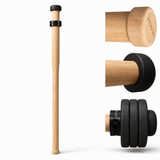
The YinYang parallettes are designed to last decades. Beech wood, magnetic interlock, four sizes to match your hands and skill level.
Shop the YinYang