






Why Your Posture Won't Fix Itself (And What Actually Will)
You've tried the stretches, the foam roller, and the standing desk. Your posture is still bad. There's a reason for that, and it has nothing to do with willpower.
If you spend most of your day looking at a screen, your head sits forward of your shoulders. You can feel it. You can see it in photos. You've probably been told to "engage your core" or "pull your shoulders back" a thousand times, and within two minutes of trying, you forget and slip right back into the same posture. This isn't a discipline problem. It's a strength problem, and almost nobody trains the muscles that would actually solve it.
01What's actually happening to your head
The human head weighs about 11 pounds. When it sits directly over your spine, your neck muscles barely have to work. They just keep it balanced. But every inch your head moves forward of that neutral position, the effective load on the back of your neck roughly doubles. At 3 inches forward, which is where most desk workers spend their day, your neck muscles are holding what feels like a 30 to 40 pound load. All day. Every day.
This is called forward head posture. It's the single most common postural distortion in the developed world, and it's the reason you have chronic tightness in your upper traps, regular tension headaches, and that nagging feeling that your neck and shoulders never quite relax even after a massage.
02Why stretching doesn't fix it
The standard advice for bad posture is to stretch. Stretch your chest, stretch your hip flexors, stretch your neck. This feels good for about an hour, then everything tightens right back up. Most people interpret that as needing to stretch more often. They're treating the wrong problem.
The muscles that hold your head in a forward position aren't tight because they're short. They're tight because they're being asked to do a job they were never built for, every single hour you're awake. Stretching them gives them five minutes of relief, then they go back to compensating. Until you build strength in the muscles that should be doing the work instead, nothing changes.
03The muscles nobody trains
The muscles that pull your head back into neutral position are called the deep cervical flexors. They sit at the front of your neck, behind the throat, and their entire job is to hold your skull stacked over your spine. For most people, they've been on permanent vacation since middle school. Phones, laptops, books, gaming. Every activity in modern life trains the front of the neck to be lengthened and weak while the back of the neck stays tight and overworked.
The fix is direct. Train those muscles. Not chin tucks against gravity, which barely load them. Not "engage your core" cues. Real progressive resistance, the same way you'd train any other muscle in the body.
04What "training" actually looks like
The neck responds to the same principles as every other muscle group. Load it, take it through full range of motion, and progress over time. The difference is the starting weight. Even strong lifters often start with just bodyweight or a few pounds, because the neck has been undertrained their entire life.
There are four key movements that fix forward head posture:
Loaded chin tucks. Press your chin straight back, like you're trying to make a double chin. Add resistance and the deep cervical flexors finally get a real stimulus.
Neck flexion. Bring your chin toward your chest under load. This builds the front of the neck, including the muscles that pull your head back over your shoulders.
Neck extension. Push your head back against resistance. Strengthens the upper traps and back of neck without making them tighter.
Lateral flexion. Ear toward shoulder, both directions. Catches the side neck muscles that get pulled out of balance when your head sits forward.
Two short sessions per week, two to three sets of each movement, with weight you can control through a slow rep. That's the entire prescription.

05Why a head harness is the only practical tool
Theoretically you can train your neck without equipment. In practice, it doesn't work very well. Hand resistance is too inconsistent to track progress. Towel exercises slip and don't load evenly. Lying with a plate on your forehead is genuinely dangerous if it shifts.
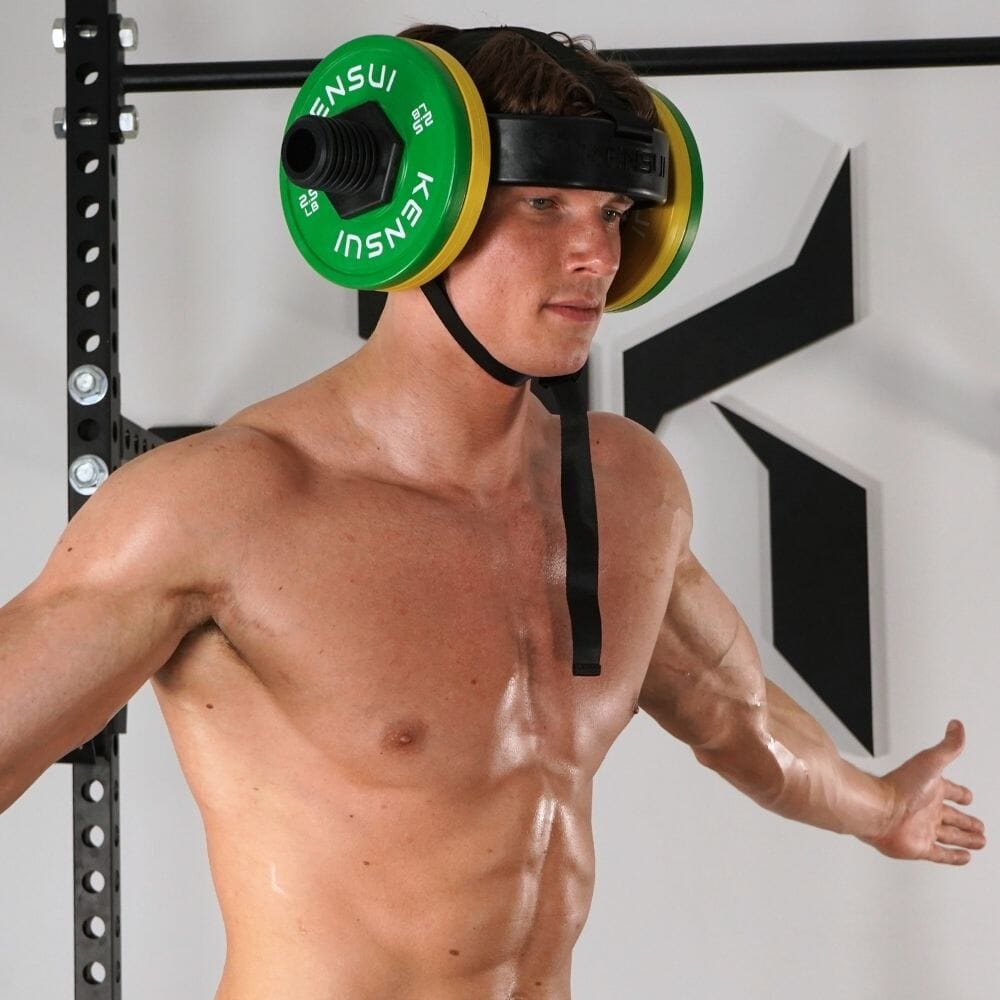
A plate-loaded head harness solves this. It distributes weight evenly across the skull, attaches to plates you already own, and lets you train every direction with controlled resistance. Most people start with just the harness itself, then gradually add weight as the muscles catch up.
06What changes (and how fast)
The first thing most people notice is the absence of something rather than a new sensation. The constant low-grade tension in the upper traps starts to fade. The neck stops feeling like it needs to be cracked or stretched every hour. Tension headaches drop in frequency, sometimes within two or three weeks.
Then the visible changes start. Your head sits back over your shoulders without you having to think about it. Photos from the side stop showing that subtle forward lean. Shirts fit differently because the line from your jaw to your shoulders is more vertical. By the eight-week mark, most people are getting unsolicited comments about looking taller or more confident.
None of this is about willpower or constantly thinking about your posture. It's about removing the strength deficit that was forcing your body into the wrong position in the first place. Once the deep cervical flexors are doing their job, neutral posture becomes the path of least resistance instead of an effortful battle.
07The side benefits that come along for free
Fixing your posture is the headline outcome, but neck training delivers a stack of secondary benefits that most fitness equipment can't claim.
Tension headaches drop sharply for most people within the first month. Sleep quality often improves because the cervical spine is no longer being held in a compromised position. Concussion risk goes down. Research from Rutgers found that every additional pound of neck strength reduced concussion odds by roughly 5%, which matters even if you never play contact sports, since most concussions happen during ordinary slips and falls.
And as a bonus, your neck looks better. Two centimeters of added circumference fills out a shirt collar, balances the head-to-shoulder ratio, and gives the upper body a more dominant silhouette. None of that was the goal, but it's hard to complain.
Fix the underlying problem
The EZ-HELM is the missing tool for actually building neck strength instead of stretching around the issue. Plate-loaded, comfortable, and designed to last.
Shop the EZ-HELM