






The Neck Is the #1 Looksmax Almost Nobody Trains
You can have a six-pack, a 250 lb bench, and shoulders for days. If your neck looks like a drinking straw holding up a basketball, none of it lands.
Take a quick scroll through any fitness feed and you'll notice something. The guys who look the most physically dominant aren't always the leanest or the strongest. They're the ones whose head and shoulders flow into each other as one continuous slab of muscle. That's not an accident. It's the single most underrated aesthetic upgrade in the entire gym, and almost nobody trains for it.
01The neck is the frame for everything above the shoulders
Your jaw, your face, your hairline, your traps. They all live inside a frame, and the neck is the frame. A thick neck makes a strong jaw look stronger. It makes shoulders look wider. It even makes the face look more masculine because of how it changes the head-to-shoulder ratio. A thin neck does the opposite, no matter what the rest of the body looks like.
This is why old-school bodybuilders trained neck obsessively. Look at any photo of Steve Reeves, Reg Park, or Mike Mentzer. The neck is roughly the same circumference as their upper arm. That proportion is what separates a built body from a body that looks built.
02The research is real and the numbers are not subtle
This isn't subjective. Researchers have actually studied perceived attractiveness against neck circumference, and the correlation is strong enough that it shows up across cultures. A thicker neck consistently rates higher on dominance, masculinity, and overall attractiveness. The brain reads it as a signal of health and physical capability before you've even said a word.
The good news is that neck circumference responds quickly to training. Published studies show measurable gains within weeks:
+1.1 cm in 8 weeks. +1.5 cm in 16 weeks. Up to +2.3 cm for high responders. Multiple peer-reviewed studies on dedicated neck training
One to two centimeters might not sound like much on paper, but on a neck, it's the difference between a shirt collar that hangs loose and one that fills out completely. People will notice within two months of training, even if they can't articulate what changed.
03Why most lifters skip it (and why that's your advantage)
Three reasons. First, most people don't know how to train it. The neck isn't a body part covered in any standard program. Second, the equipment options have historically been bad. Towel exercises feel awkward, plate-on-head balancing is dangerous, and most commercial gyms don't carry a neck harness. Third, there's a lingering belief that neck training is only for football players and wrestlers.
This is why neck training is the highest-ROI aesthetic move in the gym right now. The bar to entry is so low that even a small effort puts you ahead of 99% of lifters. Two short sessions a week is all it takes to start moving the dial.

04What "training" actually means here
You don't need a complicated program. The neck responds to the same principles as any other muscle. Progressive overload, full range of motion, and reasonable volume. The difference is the load. Even strong lifters start with very little weight, because the neck has been undertrained their entire life.
The four movements that cover the full neck musculature:
Flexion. Chin to chest. This builds the front of the neck, including the sternocleidomastoid, the muscle that creates that thick rope-like definition on the side of the throat.
Extension. Head pushed backward against resistance. This builds the back of the neck and upper traps. The piece most responsible for that thick, dominant look from behind.
Lateral flexion. Ear to shoulder, both directions. Builds the sides and gives the neck its three-dimensional fullness rather than a flat front-to-back look.
Rotation and figure-8s. Trains the deep stabilizers and finishes the muscle from every angle. Often the missing piece for people who train the four cardinal directions but still have a neck that looks unfinished.
Two to three sets of each, twice a week, with weight you can control through a slow, deliberate rep. That's the entire program.
05The tool you actually need
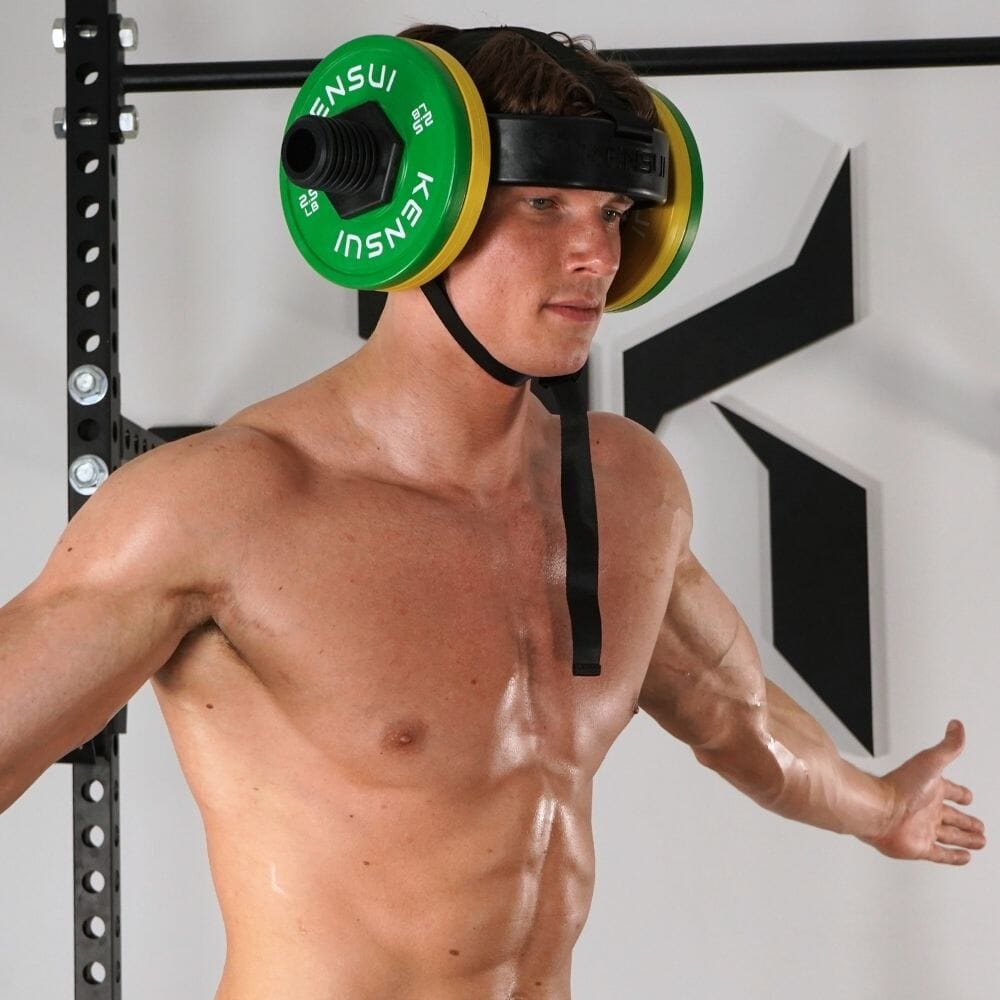
The biggest problem with neck training has always been the equipment. Towels slip, hand resistance is too inconsistent to track progress, and laying a plate on your forehead is how people get hurt. What you need is a way to attach a real weight plate to your head in a controlled, comfortable way.
That's exactly what a head harness does. The EZ-HELM is a plate-loaded helmet that distributes weight evenly across the skull, accepts any plate you already own, and lets you train all four neck movements with controlled progressive overload. It weighs 2 lbs on its own, which means even people starting from zero can train comfortably. Add plates as you get stronger.
06Side benefits you don't have to ask for
Even if you started neck training purely for aesthetics, you'd end up with a list of side benefits that most fitness equipment can't claim.
Your posture improves. The deep cervical flexors that support the head are usually the weakest muscles in the entire body for office workers, which is what creates forward head posture. Training them directly pulls your head back over your shoulders without you having to consciously think about it.
Tension headaches drop. A lot of chronic neck and shoulder tension is actually a strength problem disguised as a flexibility problem. Stretching helps for an hour, then it comes back. Strengthening fixes it.
Concussion risk goes down. Research from Rutgers found that every additional pound of neck strength reduced concussion odds by about 5%. Even if you don't play contact sports, that resilience pays off any time your head moves unexpectedly.
07The first eight weeks
Most people see visible changes in their neck within six to eight weeks of consistent training, two short sessions per week. Shirt collars start fitting differently. Photos from the side start looking different. The line from your jaw to your trap fills in.
It's one of the few training investments where the visible payoff arrives faster than the corresponding lift on a barbell. Eight weeks to add a meaningful amount of muscle to a body part nobody else is training. That's the highest leverage move in the gym, full stop.
Start filling out the collar
The EZ-HELM gives you everything needed to train the neck the right way. Plate-loaded, comfortable, portable, and built to last.
Shop the EZ-HELM